My interest in the connection between mind and body began in 2012. Meditation became a regular practice, while physical activity was something I made time for whenever I could. Over time, I began to think of these two parts of my life together as Mind: Muscle.
A health check that changed my routine
In 2016, I went to donate blood and was told that my haemoglobin was low. I was advised to eat more iron-rich foods. That unexpected finding prompted me to start having regular health checks, including tests for blood sugar, cholesterol and thyroid function.
The tests showed hypothyroidism. By 2017, my HbA1c results also indicated that I was approaching the prediabetes range. I realised I needed to pay closer attention to my health.
When I discussed my reports with Dr Ezhilan Naganathan in 2018, we talked about medication and changes to my daily habits. I decided to make a serious effort with food and exercise.
My first major change: food and walking
From October 2018, I stopped eating rice and wheat for two months and focused on vegetables, fruit and meat. I also walked five kilometres along Marina Beach every morning, whatever the weather.

By December, I had lost 10 kilograms, and my HbA1c had fallen by 1.2 percentage points. My thyroid condition had also improved, and I had stopped taking thyroid medication by the end of 2018. Seeing those changes encouraged me to keep paying attention to my habits.
That period of weight loss came mainly from eating fewer calories and walking regularly. I had not yet developed a strength training routine or paid close attention to the balance of nutrients in my diet.
Finding my way into the gym
I continued walking and being mindful of my food choices after the COVID-19 pandemic. Still, I wanted to add a more structured form of exercise. On 1 May 2022, I joined a gym closer to my home.

I didn’t know much gym language at first. One morning, while I was at the lat pulldown machine, another member asked, “What class today?”
“Morning class,” I replied.
He meant which muscle group I was training. I thought he was asking what time I had turned up. It took me a moment to understand why my answer had amused him.
What began as an unfamiliar routine became a consistent part of my life. For several years, I concentrated mainly on strength training, attending around 22 to 25 sessions a month. My cardio exercise, however, was irregular.
Why I added structured cardio
A cholesterol test in October 2024 made me reconsider that balance. I began learning more about aerobic exercise and decided to give cardio a regular place alongside strength training.
I now use two kinds of cardio sessions: steady Zone 2 walks and the more demanding Norwegian 4 × 4 intervals.
My Zone 2 walks
On Zone 2 days, I walk for 35 to 40 minutes at a steady pace. The aim is an effort I can sustain while still speaking in sentences. It gives me time to work on aerobic endurance without making every cardio session a hard workout.
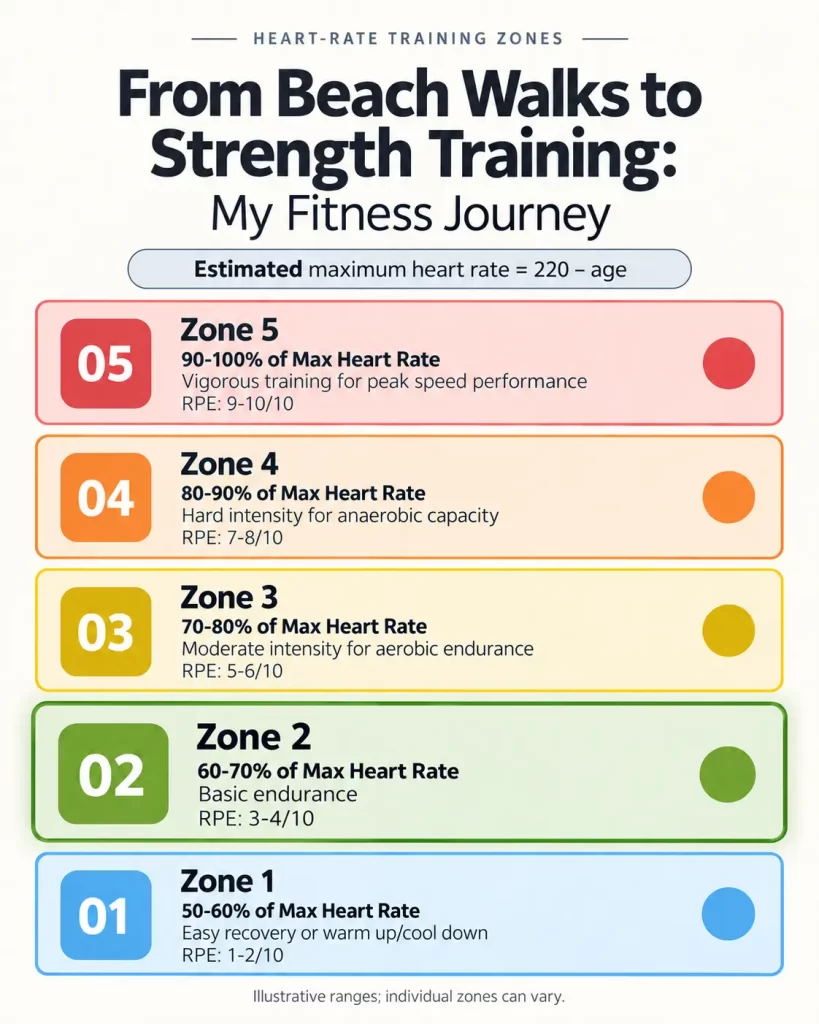
Heart-rate zones offer one way to describe exercise intensity. A common rough estimate of maximum heart rate is:
Estimated maximum heart rate = 220 − age
A commonly used estimate for Zone 2 is 60–70% of maximum heart rate. For example, at age 46, the formula gives an estimated maximum of 174 beats per minute and a Zone 2 range of roughly 104–122 beats per minute.
These numbers are guides, not precise boundaries. Different watches and training systems define Zone 2 differently, and a formula cannot measure an individual’s actual maximum heart rate. I use the numbers alongside the simpler check of whether I can maintain the pace and hold a conversation. The American Heart Association’s heart-rate guide explains the age-based estimate and its limitations.
My Norwegian 4 × 4 sessions
The Norwegian 4 × 4 is a form of high-intensity interval training. The “4 × 4” refers to four hard intervals lasting four minutes each. Between those intervals, the pace drops for approximately three minutes of active recovery—slower movement rather than stopping completely.
I currently begin with a five-minute warm-up before starting the intervals. During each four-minute effort, I increase the intensity until I am breathing hard; during recovery, I slow down so I can prepare for the next effort. I finish by easing the pace down. The Norwegian University of Science and Technology’s exercise guide describes a longer, ten-minute warm-up in its published version of the session, with the later part of each hard interval reaching roughly 90–95% of maximum heart rate.
Researchers use VO₂ max to describe the maximum amount of oxygen the body can use during intense exercise. In a 2007 exercise study, participants doing high-intensity aerobic intervals improved their VO₂ max more than participants following the comparison training methods. That finding helps explain my interest in adding intervals, although it does not tell me how much my own VO₂ max has changed; I have not measured it directly.
I was also interested in research on artery health. A 2023 randomised trial found a reduction in coronary plaque volume after six months of supervised HIIT in a small group of patients with established coronary artery disease who had undergone a coronary procedure. That is a specific clinical finding. It does not mean that doing 4 × 4 intervals will remove an artery blockage, or that my own arteries have changed in that way.
A different approach to weight loss
My approach this year differs from what I did in 2018. Back then, I relied mainly on a calorie deficit and daily walking. This time, I have combined strength training and structured cardio while paying closer attention to my overall food intake and macronutrients. My personal protein target has been approximately 2 grams per kilogram of body weight.
Around February 2026, I weighed about 73 kilograms and, as best I recall, my waist measured around 95 centimetres. I now weigh 66.5 kilograms, and my waist measures 85 centimetres. Tracking both measurements has helped me see changes beyond what the weighing scale alone shows.
Mind and muscle, together
My routine has changed many times since that blood donation in 2016. My first major change centred on food and beach walks. Years later, strength training, Zone 2 walks, intervals and a closer look at nutrition became part of the picture. Meditation has remained part of the journey throughout.
For me, Mind : Muscle is a reminder to care for both mental and physical health through regular practice.