From 18 to 20 September 2026, I attended a three-day workshop conducted by Jonathan S. Watts at the St. Thomas International Centre in St. Thomas Mount, Chennai.
Jonathan has been associated with the International Network of Engaged Buddhists (INEB) for many years and has contributed to developing the Japan Network of Engaged Buddhists (JNEB). His work connects Buddhist teachings and practices with contemporary personal and social problems.
The workshop let us use the Four Noble Truths as a practical framework for examining a problem, understanding its conditions, and developing possible responses. It also included group discussions, presentations and meditation based on the Satipaṭṭhāna Sutta.

Understanding the Four Noble Truths
The Four Noble Truths are known in Pāli as the Cattāri Ariyasaccāni. They are among the fundamental teachings of the Buddha:
- Dukkha – the truth of dukkha
- Samudaya – the truth of the origin or cause of dukkha
- Nirodha – the truth of the cessation of dukkha
- Magga – the truth of the path leading to the cessation of dukkha
In their fuller Pāli forms, they are:
- Dukkha Ariyasacca
- Dukkhasamudaya Ariyasacca
- Dukkhanirodha Ariyasacca
- Dukkhanirodhagāminī Paṭipadā Ariyasacca
The Pāli word dukkha is commonly translated into English as “suffering.” Although suffering is part of its meaning, the English word does not convey its full scope. Dukkha can also include dissatisfaction, unease, instability and the inability of conditioned experiences to provide lasting fulfilment.
Reducing dukkha to suffering can give newcomers the impression that Buddhism views life pessimistically. That misses the direction of the Buddha’s teaching. The Four Noble Truths do not stop with the recognition of dukkha. They examine its causes, affirm the possibility of its cessation and provide a path towards liberation.
The path taught by the Buddha is the Ariya Aṭṭhaṅgika Magga, the Noble Eightfold Path. Its purpose is the cessation of dukkha and the realisation of Nibbāna.
This practical movement, from recognising a problem to working towards its cessation, formed the basis of the workshop.
Beginning with the Bodhisattva vows
Participants were introduced to the Four Bodhisattva Vows, referred to using the Sanskrit term Bodhisattva Praṇidhāna:
- Sentient beings are numberless; I vow to liberate them.
- Delusions are inexhaustible; I vow to transform them.
- Paths of truth are infinite; I vow to master them.
- The enlightened way is unsurpassed; I vow to attain it.
Bodhisattva and praṇidhāna are Sanskrit terms associated with the Mahāyāna Buddhist tradition. The corresponding Pāli form of Bodhisattva is Bodhisatta, meaning a being who is intent on awakening.
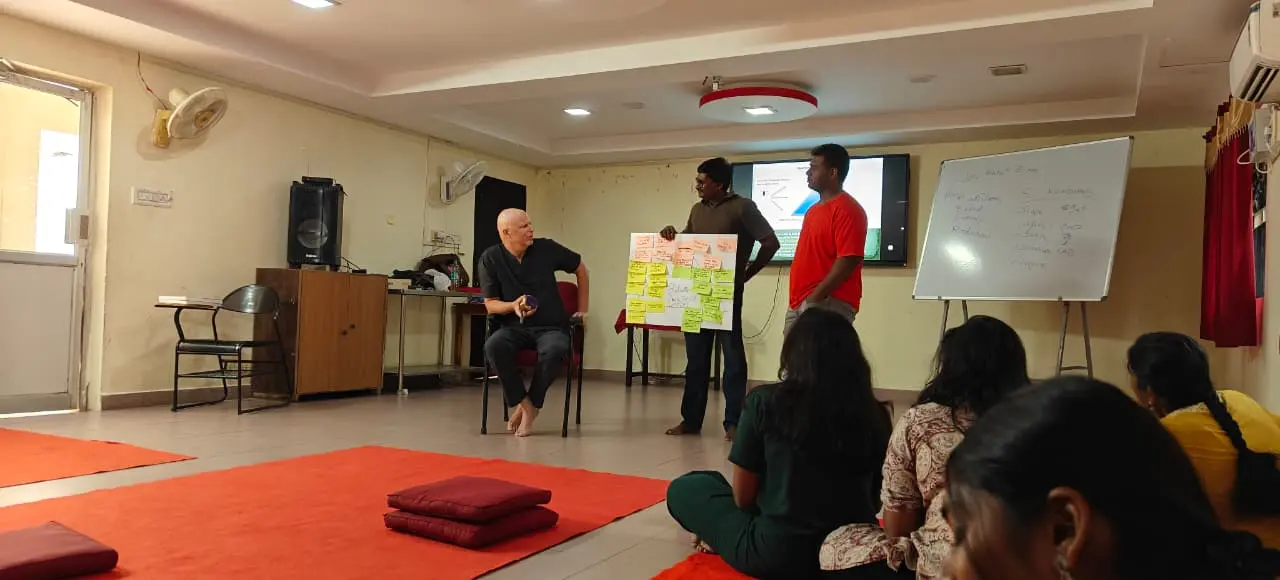
We were asked to write our own vows in relation to concerns that mattered to us. Participants then formed groups based on the issues they had chosen.
The first stage was to identify the dukkha connected with each issue. Instead of discussing it only as an individual difficulty, we examined the social conditions surrounding it.
Looking beneath the visible problem
One of the workshop’s useful models was the image of an iceberg. The pain or difficulty that we notice is only the visible part. Beneath it may lie structural and cultural forms of violence that allow the problem to continue.
Structural violence concerns the how. It can be found in systems, institutions, policies and established methods of functioning.
Cultural violence concerns the why. It includes the values, beliefs, symbols and concepts used to justify or normalise those structures.
Each group discussed the structural and cultural conditions connected with its chosen dukkha. We consolidated our observations and presented them to the other participants. This made us look beyond the immediate symptoms and ask what repeatedly produces or sustains the problem.
It also showed why personal difficulties cannot always be understood in isolation. A person’s experience may be affected by family expectations, social practices, economic arrangements, institutions or beliefs that have been accepted without sufficient examination.
Moving from analysis to action

Recognising dukkha and analysing its causes covered the first two Noble Truths. The next task was to consider what nirodha, or cessation, might look like.
Each group developed a vision of the conditions that could exist if the chosen dukkha were reduced or brought to an end. We were also asked to identify “holding actions”: practical measures that could support people and prevent further harm while bigger changes were being developed.
For the fourth Noble Truth, magga, the groups proposed alternative social and cultural structures. This meant moving beyond criticism and considering what systems, practices, values and relationships would need to replace the harmful ones.
The process gave us direct experience of using the Four Noble Truths to work through a contemporary problem:
- What is the dukkha?
- What is its samudaya, or cause?
- What would its nirodha, or cessation, look like?
- What magga, or path, could lead towards that cessation?
The value of the exercise was its insistence on completing the entire process. It is easy to identify a problem and continue thinking about it without reaching a response. The framework required us to define the problem carefully, examine its causes and then work towards a realistic course of action.
Satipaṭṭhāna and understanding the mind
Alongside the group exercises, Jonathan explained the Satipaṭṭhāna Sutta, an important discourse on the establishment of mindfulness.
The term Satipaṭṭhāna is commonly understood as the establishment or foundation of mindfulness.
The practice is organised around four areas of contemplation:
- Kāyānupassanā – contemplation of the body
- Vedanānupassanā – contemplation of feelings
- Cittānupassanā – contemplation of the mind
- Dhammānupassanā – contemplation of dhammas or categories of experience
In simpler terms, these involve observing:
- Kāya: the body, breathing and bodily postures
- Vedanā: pleasant, unpleasant and neutral feelings
- Citta: the mind and its changing states
- Dhammā: mental qualities and patterns understood through the Buddha’s teaching
Dhammānupassanā includes the contemplation of teachings such as:
- The five hindrances, pañca nīvaraṇāni
- The seven factors of awakening, satta bojjhaṅgā
- The five aggregates, pañcakkhandhā
We practised meditation based on these foundations during the workshop. This helped connect the social analysis with observation of our own bodies, feelings and minds.
Buddhist practice is not limited to discussing ideas. Meditation, or bhāvanā, provides a way to observe the mind directly, including its reactions and habitual patterns. With continued practice, a person can understand these patterns more clearly and gradually change the conditions that support unwholesome responses.
This inner work is relevant even when the problem being considered is social. Attempts to change external structures can reproduce anger, attachment or prejudice when the people involved do not examine their own minds.
The Satipaṭṭhāna Sutta in the Tipiṭaka
The teachings of the Buddha, preserved in the Pāli Canon, are collectively called the Tipiṭaka, meaning “three baskets.” Its three main divisions are:
- Vinaya Piṭaka – the collection containing the rules and disciplinary framework for monastic life
- Sutta Piṭaka – the collection containing discourses on the Dhamma
- Abhidhamma Piṭaka – the collection presenting a systematic analysis of the mind, mental qualities and experience
The Satipaṭṭhāna Sutta is found as discourse 10 in the Majjhima Nikāya, the Collection of Middle-Length Discourses within the Sutta Piṭaka. A longer version, the Mahāsatipaṭṭhāna Sutta, appears as discourse 22 in the Dīgha Nikāya, the Collection of Long Discourses.
The Satipaṭṭhāna Sutta shows that mindfulness involves more than simply paying attention to the present moment. It presents a structured practice for observing the body, feelings, mind and dhammas. This practice is directed towards understanding experience, overcoming dukkha and progressing towards liberation.
A conversation about Buddhism in Japan
Jonathan is also the author of the two-volume Engaged Buddhism in Japan. The first volume examines the history of engaged Buddhism in Japan from ancient to modern times. The second looks at socially engaged Buddhist activities in twenty-first-century Japan, including responses to the problems of what has been described as Japan’s “disconnected society,” or mu-en shakai.
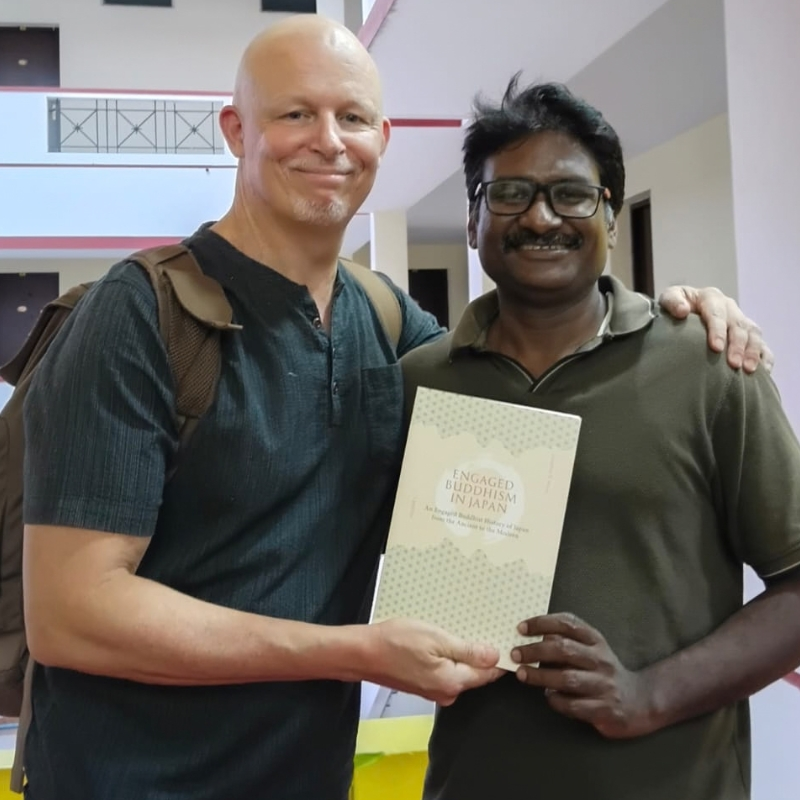
During the workshop, I had an opportunity to ask Jonathan about a question that had remained with me after reading Made in Japan by Sony co-founder Akio Morita.
Morita came from a Buddhist family that had been involved in sake production for generations. I found this difficult to reconcile with the fifth Buddhist precept, which concerns abstaining from intoxicants.
The Pāli wording of the fifth precept is:
Surāmerayamajjapamādaṭṭhānā veramaṇī sikkhāpadaṃ samādiyāmi.
It can be translated as:
I undertake the training rule to abstain from alcoholic drink and intoxicants that cause heedlessness.
How could a family influenced by Buddhism continue to own a business based on alcohol?
Jonathan explained that sīla, or ethical conduct, has often received less emphasis within parts of Japanese Buddhist life. His answer helped me understand that the way Buddhism is practised can vary considerably between cultures. A society may retain Buddhist institutions, ceremonies and family affiliations without giving equal importance to every aspect of Buddhist training.
This conversation was valuable because it addressed a question that had troubled me for some time. It also reminded me not to assume that Buddhism is understood or practised identically in every Buddhist country.
What I took away from the workshop
The workshop did not present the Four Noble Truths only as a doctrine to be memorised. It gave us a method for working with problems that we encounter personally and socially.
The group process required us to listen, discuss and present our views. Different participants saw different causes behind the same issue, and those differences made the analysis more complete.
My main takeaway was simple: when confronted with dukkha, we do not have to remain trapped in complaint or continue brooding over it. We can identify it clearly, investigate its samudaya, consider the possibility of nirodha and work out a magga towards change.
The workshop also showed that inner cultivation and social action need not be treated as separate concerns. Meditation helps us observe the habits of our own minds. Social analysis helps us recognise the systems and beliefs operating around us. Both forms of understanding are necessary if our response is to be thoughtful and responsible.
My interactions with Jonathan and the other participants made these three days worthwhile. More importantly, the workshop gave me a framework that I can continue to examine and apply after the event.